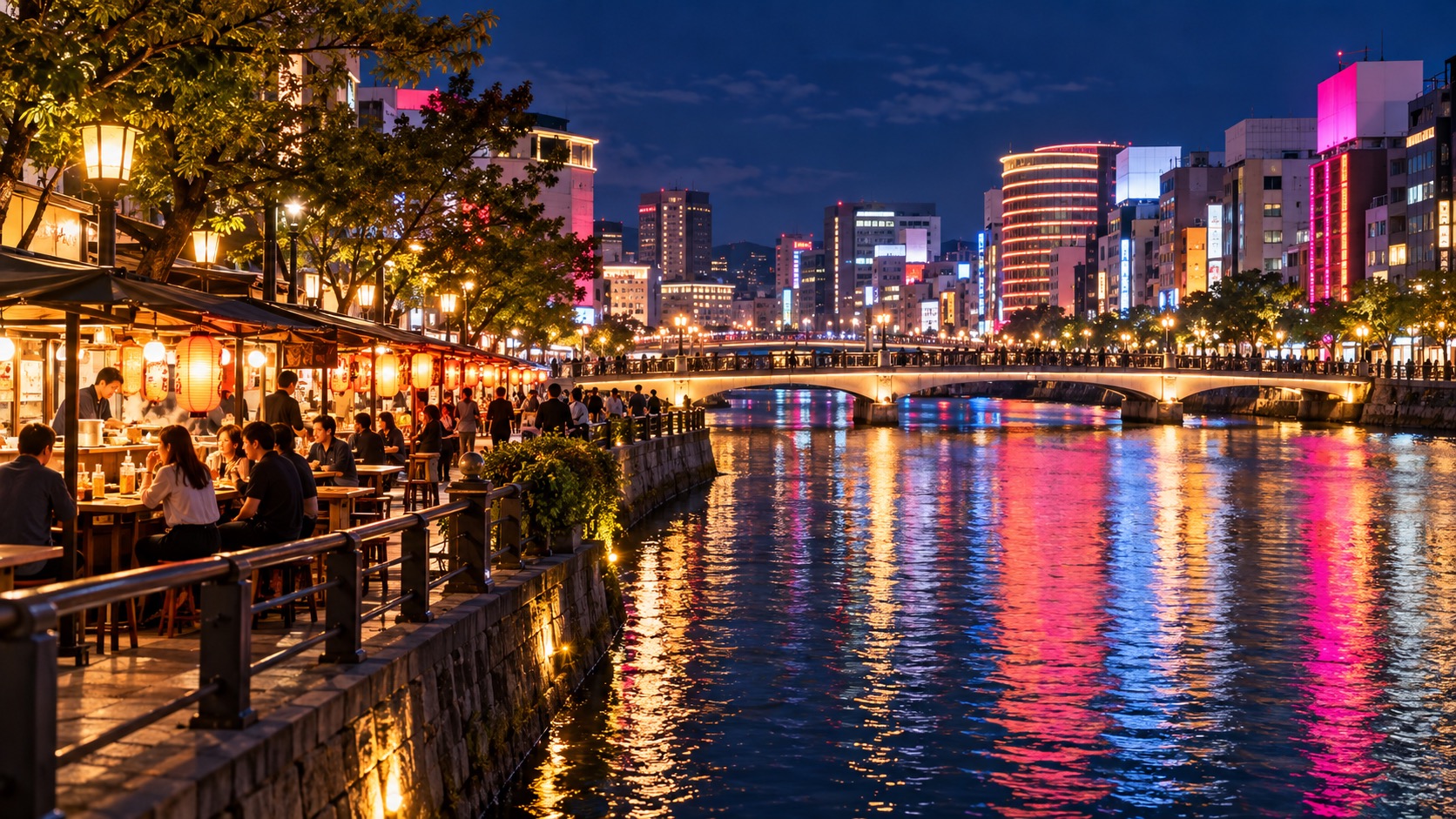
Nakasu is Fukuoka’s neon nightlife hub, but its food stalls, drinking venues and adult businesses are different subjects. Yatai means a food stall. A hostess-style club describes drinking entertainment. Soapland and delivery health describe adult-industry formats. None of those words is a synonym for the whole neighborhood.
You may have just finished ramen and drinks at a yatai and started searching “Fukuoka escort” or “Nakasu nightlife.” The results can combine food, clubs and adult-service listings without explaining how the categories fit together. Here is the distinction that should come before a long list of names.
Fukuoka, Hakata, Tenjin and Nakasu
| Name | What the label tells you | What it leaves open |
|---|---|---|
| Fukuoka | Broad city or prefecture context, depending on the page | The exact municipality and neighborhood |
| Hakata | A local area name, also used in transport and cultural descriptions | Whether the subject is specifically Nakasu |
| Tenjin | Another central Fukuoka area | The business format |
| Nakasu | A specific nightlife neighborhood | Whether a page means food, drinks, performance or an adult-service category |
Fukuoka: guide-area names and business subjects are different layers
Hakata Station Area
Nakasu-Kawabata Area
Tenjin Area
Yatai: food stalls.
Hostess-style drinking entertainment: conversation and drinks.
Soapland / deriheru: distinct adult-industry formats.
Yatai are part of the scene, not an adult-service label
Fukuoka’s official tourism page describes food stalls in Nakasu and Tenjin and the neon riverfront scenery around Nakasu. That explains why a nightlife search returns so much food coverage. The stalls are not a coded term for sexual services.
The food stalls provide the starting point for many visitors’ evening. After dinner, a search for another kind of nightlife needs the next level of detail: a specific neighborhood and a clearly described format.
Drinking entertainment and sexual-service formats
A club or lounge description can involve staff entertainment with drinks. An adult sexual-service category is a different format. English “nightlife” is wide enough to cover both, which makes it a poor substitute for the Japanese label.
Soapland refers to an adult bathhouse format, while deriheru means delivery health, an adult outcall expression. A directory might put these categories under one Fukuoka regional menu. The menu heading does not make them interchangeable, and a riverfront location does not identify the format.
Why a Fukuoka directory can extend beyond Nakasu
A regional directory can group the whole city or prefecture, while a city tourism guide uses more specific labels such as Hakata Station Area, Nakasu-Kawabata Area and Tenjin Area. These labels organize different scopes. A broad Fukuoka heading is not a precise description of the riverfront district.
This difference is easy to miss on a phone. A familiar city label at the top can distract from the narrower place name below. Keep the actual locality in a comparison table rather than treating every result headed “Fukuoka” as a Nakasu result.
After the yatai: the neighborhood question changes
The riverfront is the part of Nakasu many visitors recognize first. Fukuoka City’s tourism guide describes the Naka River’s neon reflections and food stalls, with the Fukuoka Deai Bridge as a recognizable night-view spot. Once you move from dinner to another kind of nightlife search, the familiar riverside image is still useful for orientation. It no longer answers the question of what sort of business a result describes.
That is why a good local comparison needs two layers. The first is where: Nakasu, a different part of Hakata, Tenjin, or somewhere else in Fukuoka. The second is what: a drinking venue, a performance, accommodation or a named adult-industry format. Both layers matter when you have limited attention and are checking a phone between conversations.
A result that says “Fukuoka” may answer a city-wide question, while an explanation of Nakasu and the riverfront answers a neighborhood question. The useful comparison keeps the geographic scale beside the subject: food stalls, hosted drinks, performance, accommodation or adult-industry terminology. A list of names alone cannot make those categories clear.
Compare the formats on one screen
| Term | What it means in this context | What a useful profile adds |
|---|---|---|
| Soapland | A premises-based adult bathhouse category | Current name, locality and the category its source uses |
| Deriheru / delivery health | An outcall adult-industry expression | Stated coverage, distinguished from an office address |
| Hostess club / lounge | Drinking and staff entertainment | The venue’s own format description |
| Performance venue | A show or stage-entertainment setting | What kind of performance the source actually describes |
| Love hotel | Accommodation | A location and room-information source, not an inferred adult service |
The word health in Deriheru is an industry term, not a wellness promise. The English umbrella word escort is also less precise than the Japanese format. Our Deriheru explainer and Japan escort-service comparison give the longer definitions; this page anchors them in a Fukuoka night out.
Two ways a page can organize the same city
One page may begin with a business-format heading, while another begins with a Fukuoka regional heading. The first groups a subject; the second groups a place. Neither heading, by itself, establishes the other. That explains why similar-looking English pages can contain different kinds of information.
The city’s own guide provides a concrete geographic countercheck: it separates the Hakata Station, Nakasu-Kawabata and Tenjin area headings. Its nighttime feature also discusses yatai in both Nakasu and Tenjin. A food-stall scene is therefore not a synonym for Nakasu, and Nakasu is not a synonym for every nightlife subject.
The local terminology used in this guide
Adult-industry slang can vary between pages. An unfamiliar romanization is not enough to establish a distinct Fukuoka format. Check the Japanese spelling and what the source actually describes before translating it into a new category.
This edition uses the verified labels soapland, delivery health and drinking entertainment. It does not introduce an uncertain regional spelling as fact. That keeps the article direct while avoiding a glossary built from copied mistakes.
The useful question behind “foreigner-friendly Nakasu”
An English page shows that someone has prepared English content. It does not establish that every venue in the neighborhood has English-speaking staff or identical visitor conditions. Those are separate, business-specific claims.
For an informational reader, the meaningful distinction is between language on a website and language in an actual interaction. Treat “foreigner-friendly” as a claim needing a defined meaning, rather than as a property of the entire district.
Quick answers for a Nakasu night out
Does yatai mean adult entertainment?
No. It means a food stall.
Are Hakata and Nakasu interchangeable?
No. Nakasu is a more specific neighborhood; broader Hakata descriptions can cover other places.
Does a “Fukuoka escort” page only cover Nakasu?
Not necessarily. Its geographical coverage may be much wider.
Sources and verification
Rechecked 11 November 2026: Fukuoka City’s Nakasu and yatai feature describes food stalls in Nakasu and Tenjin, the Naka River’s neon scenery and the Fukuoka Deai Bridge. The city area guide and its area navigation distinguish Hakata Station Area, Nakasu-Kawabata Area and Tenjin Area. These tourism categories are not administrative boundary declarations. Tokyo Metropolitan Police’s business-category list and Imidas’s deriheru entry support the separate format terminology. No commercial listing, language policy or personal visit is independently verified by a riverfront image.